
Air Cleaners Improve Quality of Life In Smokers With COPD
Background Breathing “bad air” both indoors and outdoors is hazardous for everyone’s health. Particulate matter of 2.5 micron diameter size can easily be inhaled deep into the lungs causing inflammation and airway constriction (see figure below for different sizes of particulate matter).
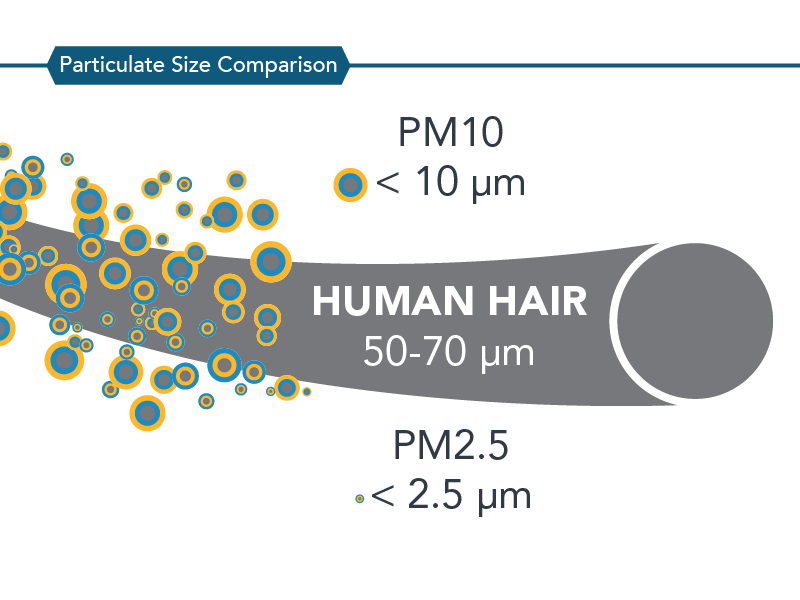
Comparison of particulate matter 2.5 and 10 microns in diameter with a human hair
Rationale The aim of the study was to assess whether an environmental intervention to improve air quality and reduce second hand smoke improves health outcomes.
Study Current smokers with COPD were assigned by chance to receive two active portable high-efficiency air cleaners and motivational interviewing (MI) OR two sham air cleaners without MI. The air cleaners were to reduce partiulate matter while MI was intended to reduce exposure to second hand smoke. The study design is shown in the figure below.
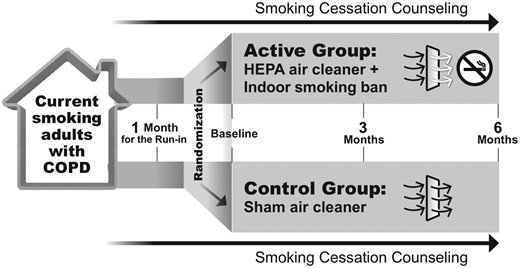
Study design
Air cleaners were placed in the bedroom and room the participant reported spending the most time while awake.
The primary outcome was the change in a quality of life questionnaire (St. Geroge’s Respiratory Questionnaire - SGRQ) at 6 months. Other outcomes included respiratory symptoms, risk of a flare-up (exacerbation), and lung function.
Results 99 of 121 participants who were randomized completed the study. As expected, air cleaners reduced indoor particulate matter compared with control (sham) group (See changes in figure below).
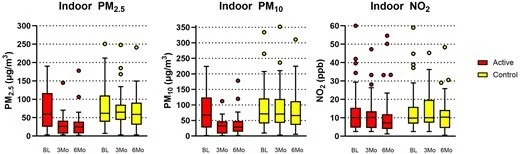
Reductions in particulate matter 2.5 and 10 micron and indoor nitrogen dioxide (NO2) with active air cleaners (red boxes) and sham air cleaners (yellow boxes)
Those in the active air cleaners group had significant improvement in quality of life (SGRQ) conmpared to control group. In addition, patients in air cleaner group reported less coughing and less shortness of breath comparee with the control group. However, there was no differences in lung function, sputum, or flare-ups over the 6 months.
The study was conducted by Dr. Nadia Hansel and colleagues at the Johns Hopkins University School of Medicine. The results were published in the May 2026 issue of the American Journal of Respiratory and Critical Care Medicine, volume 212; pages 952-963.
Conclusions This is the first report to demonstrate health benefits of high-efficiency air cleaners in active smokers with COPD.
My Comments Most patients with COPD living in the United States and other developed countries spend the vast majority of their time (>90%) indoors. In addition to efforts directed at helping patients quit smoking, more attention to the impacts of indoor air quality on patients with COPD is warranted.
I advise patients in my practice to consider buying one or more portable HEPA filtration device(s). The air cleaners used in this study were the Rabbit Air Minus A2 Model 700A and 780A (see below). An online search indicates the cost is $599. However, other less expensive air cleaners are available for $100 to $200.
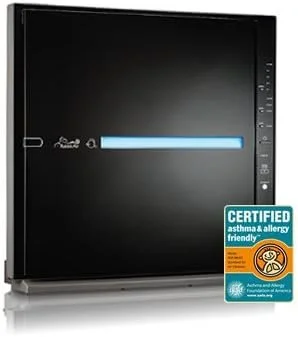
Rabbit Air, MinusA2 Ultra Quiet HEPA Air Purifier